Numerical Methods
gFlex solves the flexure equation by three strategies: superposition of analytical solutions (SAS / SAS_NG), a spectral FFT solver, and a finite-difference (FD) solver. See Theory for the governing equations and a comparison of the strategies.
This page gives the mathematical form of each solver and, for the FD solver, shows how the governing PDEs map onto the interior stencils. Stencils that enforce the domain boundary conditions are described in Boundary Conditions.
Superposition of analytical solutions (SAS / SAS_NG)
The SAS solver exploits the linearity of the flexure equation to superpose Green’s-function responses to individual point or line loads (Wickert, 2016, Eqs. 7–8).
1-D (line load)
The deflection at position \(x\) due to a line load of magnitude \(q\) centred at \(x_i\) is (Wickert, 2016, Eq. 3)
where
is the one-dimensional flexural parameter. The full deflection is the sum of these responses over all loaded grid cells, each multiplied by the cell width \(\Delta x\).
2-D (point load) — Kelvin–Bessel function
The two-dimensional response to a point load \(q\) at \((x_i, y_j)\) is (Wickert, 2016, Eq. 5; Brotchie and Silvester, 1969)
where
is the two-dimensional flexural parameter, and \(\mathrm{kei}\) is the zeroth-order Kelvin–Bessel function — the imaginary part of \(K_0(r\,e^{i\pi/4})\), with \(K_0\) being the zeroth-order modified Bessel function of the second kind (Abramowitz and Stegun, 1972). The total deflection is the sum over all point loads (Wickert, 2016, Eq. 8).
Spectral (FFT) solver
The FFT solver works in the wavenumber domain. For uniform \(D\) the deflection spectrum is obtained by dividing the transformed load by the spectral stiffness.
1-D
With angular wavenumber \(k\):
where \(Q(k)\) is the Fourier transform of the load and \(\sigma_{xx}\) is the optional in-plane (end) normal stress.
2-D
With angular wavenumbers \(k_x\) and \(k_y\):
For non-periodic boundary conditions both transforms zero-pad the load by four flexural wavelengths on each side before transforming, then trim the result back to the original domain.
Finite-difference interior stencils
The FD solver replaces each spatial derivative in the governing PDE with a second-order centred finite difference (Fornberg, 1988, Table 1) to assemble a sparse linear system (Wickert, 2016, Eq. 11)
where \(\mathbf{A}\) is the coefficient (operator) matrix, \(\mathbf{w}\) is the vector of unknown deflections, and \(\mathbf{q}\) is the imposed load.
1-D governing equation
The one-dimensional flexural isostasy equation for a plate of variable rigidity \(D(x)\) (Wickert, 2016, Eq. A19) is
Expanding the outer derivative (Wickert, 2016, Eq. 9) and adding the in-plane (end-load) normal stress \(\sigma_{xx}\):
For uniform \(D\), applying the second-order central-difference approximation of the fourth derivative at node \(i\),
gives the stencil equation at each interior node:
With \(\sigma_{xx} = 0\) this is the biharmonic stencil with integer weights \((+1,\,-4,\,+6,\,-4,\,+1)\) scaled by \(D/\Delta x^4\), with \(\Delta\rho\,g\) absorbed into the centre coefficient. For variable \(D\), the \(D\)-gradient terms additionally couple the stencil weights across neighbouring nodes.
1-D interior stencil — five-point stencil spanning two nodes on each side of the evaluation point:
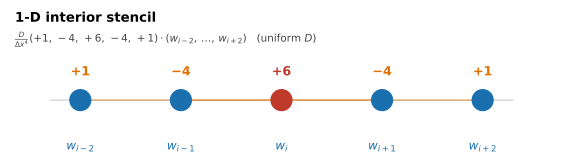
Five-point 1-D stencil: \(\tfrac{D}{\Delta x^4}(+1,\,-4,\,+6,\,-4,\,+1)\) applied at each interior node (uniform \(D\)).
2-D governing equation
The two-dimensional equation follows van Wees and Cloetingh (1994) and, in compact form (Wickert, 2016, Eq. A20), is
where \(\hat{\boldsymbol{\kappa}}\) is the curvature operator and \(\mathbf{D}\) is the plate rigidity matrix (Wickert, 2016, Eqs. A9–A12). Expanded for variable \(D\) (Wickert, 2016, Eq. 10):
In-plane stresses \(\sigma_{xx}\), \(\sigma_{yy}\), and \(\sigma_{xy}\) add to the left-hand side:
For uniform \(D\) on a square grid (\(\Delta x = \Delta y = h\)), the equation reduces to \(D\nabla^4 w + \Delta\rho\,g\,w = q\), and the thirteen-point stencil equation at interior node \((i,j)\) is
The integer weights arise from expanding \(h^4\nabla^4\): centre \(+20\), four nearest axis neighbours \(-8\), four next-nearest axis neighbours \(+1\), and four diagonal neighbours \(+2\).
2-D interior stencil — thirteen-point stencil on a square \((\Delta x = \Delta y = h)\) grid: centre coefficient +20, the four nearest neighbours −8, the four next-nearest along each axis +1, and the four diagonal neighbours +2.
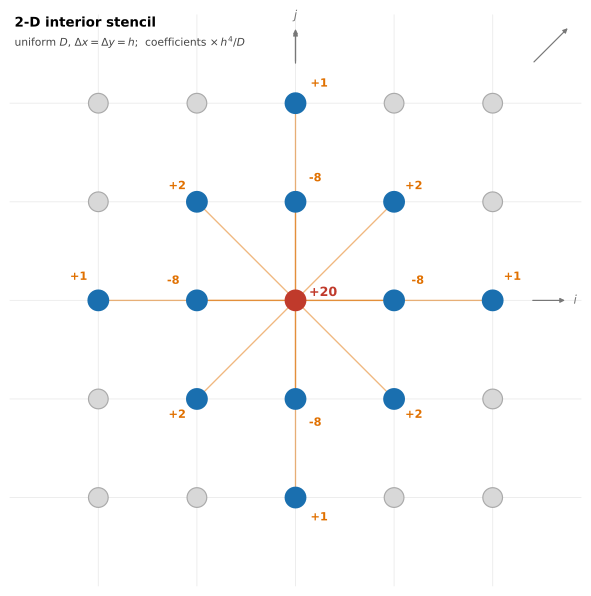
Thirteen-point 2-D stencil for the biharmonic operator on a square grid (uniform \(D\)).