Boundary Conditions
Boundary conditions specify what happens at the edges of the modelled domain.
gFlex supports six named conditions for the finite-difference (FD) solver;
four impose constraints on which plate mechanical quantities — deflection,
slope, bending moment, and shear force — vanish at that edge; one
(periodic) connects opposite edges in a wrap-around domain; and one
(no_outside_loads) automatically extends the domain before solving.
Five short aliases (clamped, pinned, free, mirror, infinite) are also accepted.
The interior finite-difference stencils are derived in Theory and Numerics;
this page covers the boundary-node stencils and their physical interpretations.
For the spectral (FFT) solver, boundary conditions are handled per opposite-edge
pair (W/E and N/S independently): if both sides of a pair are set to
periodic, that axis uses an exact periodic solution; otherwise the axis is
zero-padded by \(\approx 4\alpha\) before solving, which is equivalent to
no_outside_loads for that axis. The analytical-superposition (SAS / SAS_NG)
methods always assume no_outside_loads.
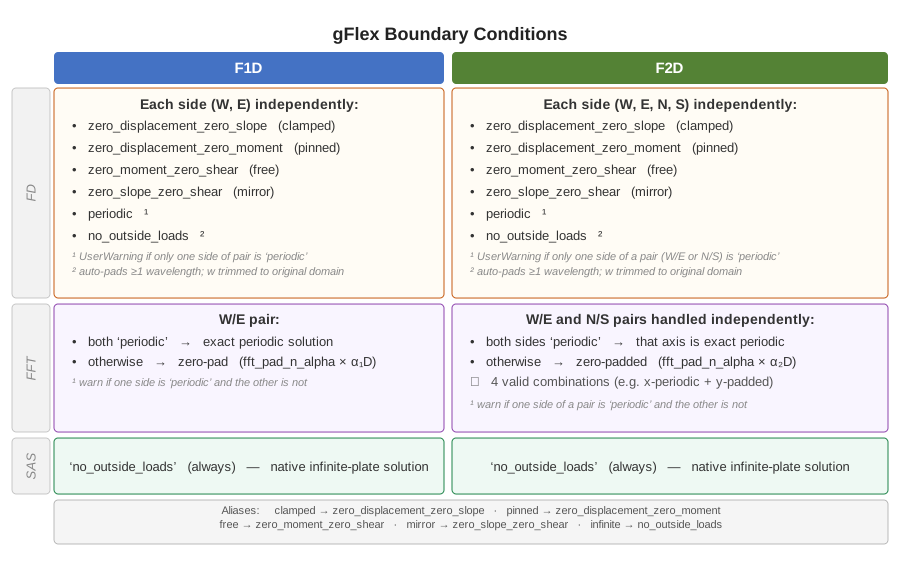
Overview of all boundary conditions and their applicability across solver families (FD, FFT, SAS) and dimensionality (F1D, F2D).
The following figure from Wickert (2016) illustrates four of the five
mechanically-named conditions (zero_displacement_zero_moment was added
after publication):
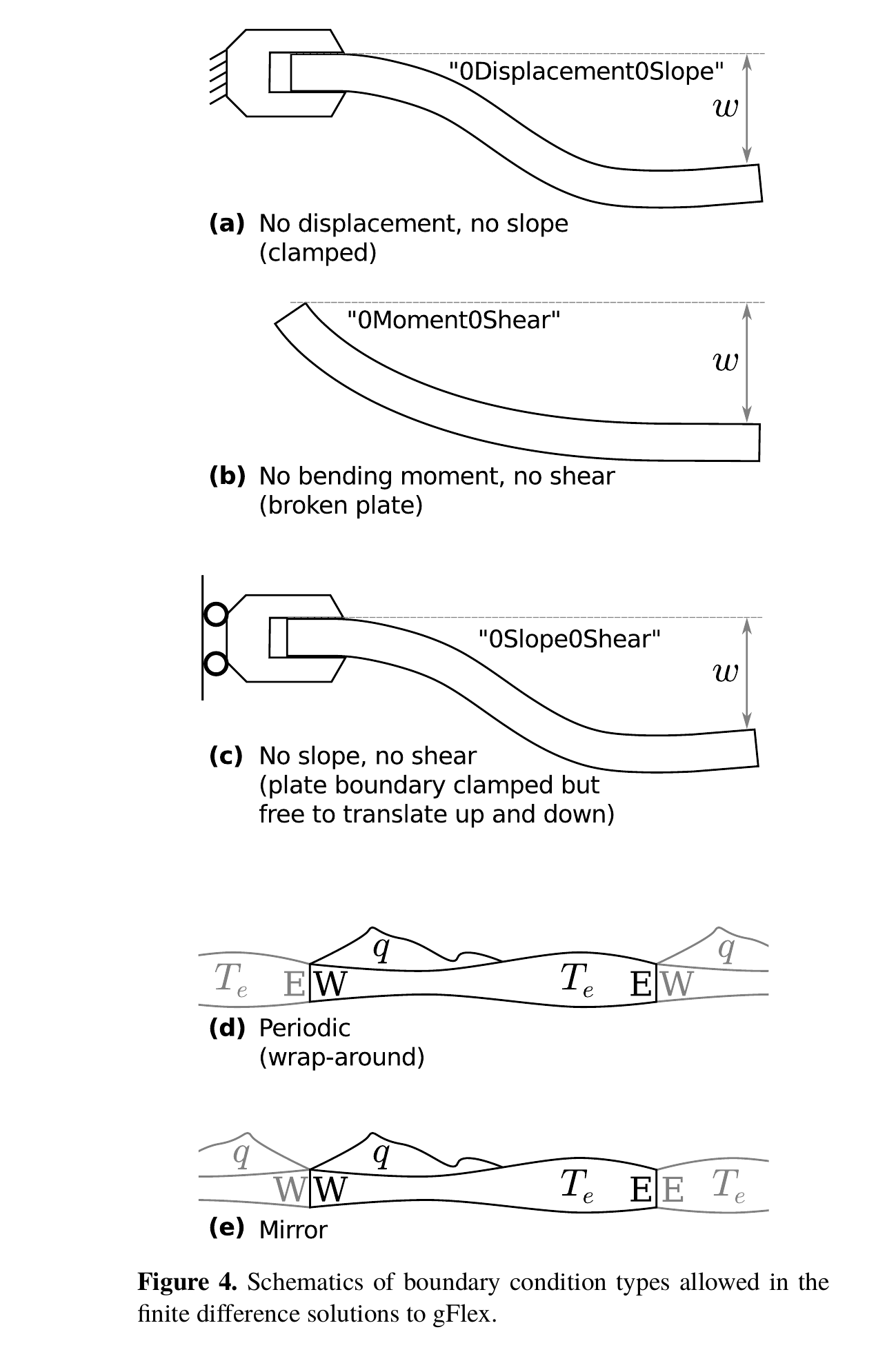
Schematics of five FD boundary condition types (a–e) from Wickert (2016),
Fig. 4 (CC BY 3.0).
zero_displacement_zero_moment (added post-publication) is not shown.
Tip
Flexural solutions can be sensitive to boundary conditions. When in
doubt, use pad_domain() to push the boundaries far from the
region of interest (works for both 1-D and 2-D), and choose
zero_moment_zero_shear (free end) to minimise their influence.
Quantity names
The boundary condition names encode which plate mechanical quantities vanish at that edge. The table below maps each name component to its physical meaning and derivative order.
Quantity |
Symbol |
Definition (uniform \(D\), 1-D) |
\(w\)-derivative order |
|---|---|---|---|
Deflection |
\(w\) |
\(w\) |
0th |
Slope |
\(S\) |
\(\frac{\mathrm{d}w}{\mathrm{d}x}\) |
1st |
Bending moment |
\(M\) |
\(D\,\frac{\mathrm{d}^2 w}{\mathrm{d}x^2}\) |
2nd |
Shear force |
\(V\) |
\(D\,\frac{\mathrm{d}^3 w}{\mathrm{d}x^3}\) |
3rd |
Conditions
The table below summarises the five conditions. Detailed descriptions, geological context, and ball-and-stick diagrams appear in the sections below.
gFlex name |
Zero at boundary |
Structural mechanics |
Geophysical |
Description |
|---|---|---|---|---|
|
\(w\),\(S\) |
clamped end |
— |
No deflection, no rotation |
|
\(w\),\(M\) |
simply supported / pinned |
— |
No deflection, free to rotate |
|
\(M\),\(V\) |
free end |
broken plate |
Free, unsupported plate end |
|
\(S\),\(V\) |
— |
mirror / symmetry |
Even reflection; model half of a symmetric system |
|
— |
— |
— |
Domain wraps; opposite edges connected (per-axis pair for FFT) |
|
— |
— |
semi-infinite plate |
Auto-pad by ≥1 \(\alpha\); |
The “Geophysical” column reflects established usage in the lithospheric
flexure literature. zero_moment_zero_shear is known as the “broken plate”
condition; zero_slope_zero_shear (short alias mirror) is used under
the symmetry-plane or mirror name in geophysical modeling.
The remaining conditions are referred to by their structural-mechanics names,
or have no name at all.
Deprecated since version 2.0: The v1.x PascalCase boundary-condition strings are no longer accepted. Rename them as follows:
Old name (v1.x) |
New name (v2.0+) |
|---|---|
|
|
|
|
|
|
|
|
|
|
|
|
|
|
zero_displacement_zero_slope
Zero displacement and zero slope: the plate is fully clamped at the boundary — no deflection and no rotation.
Standard names: clamped end (structural mechanics). No established geophysical name.
Geological context: No natural lithospheric analogue has been identified. The condition physically requires the plate to be rigidly anchored against both vertical movement and rotation at its edge, which has no clear counterpart in Earth’s lithosphere. In practice it serves as a conservative far-field constraint: when the domain boundary is placed far from any load and the plate is expected to be undisturbed there, clamping holds the plate at zero and zero slope — somewhat more conservative than the free-end condition at the same location. It is most appropriate as a boundary for a synthetic or test model, not as a representation of a physical plate edge.
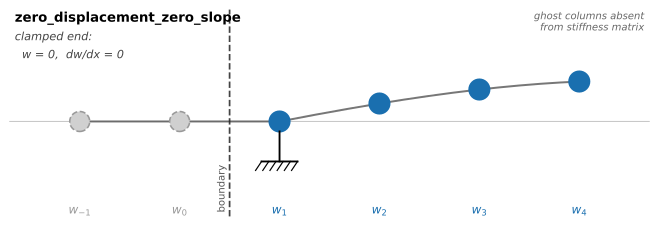
Clamped end — zero deflection and zero slope at the boundary.
zero_displacement_zero_moment
Added in version 2.0.0.
Zero displacement and zero bending moment: the classical simply-supported (pinned) plate end. The plate is held at zero deflection but is free to rotate, so no moment is transmitted. Implemented as a Dirichlet condition (\(w = 0\)) at the boundary node and an odd-reflection ghost (\(w_\text{ghost} = -w_\text{interior}\)) at the first interior node to enforce zero curvature.
Standard names: simply supported or pinned end (structural mechanics). No established geophysical name.
Geological context: No natural lithospheric analogue has been identified.
The condition is a mathematical convenience rather than a physical one: it
is the natural condition for sine-series (Discrete Sine Transform) spectral
solutions, where pinning both ends in deflection and freeing them in moment
yields an odd-periodic extension that supports spectral computation without
edge artefacts. Sine modes vanish at a simply-supported boundary; cosine
modes vanish at a mirror boundary (see below).
Contrast with mirror
mirror and zero_displacement_zero_moment are both reflection boundary
conditions but encode opposite parities. mirror uses an even
reflection (\(w_\text{ghost} = +w_\text{interior}\)): the symmetry
plane lies between the last real node and its ghost, the plate is horizontal
at the boundary, and the deflection there is generally non-zero — making it
the correct choice for modelling one half of a symmetric system.
zero_displacement_zero_moment uses an odd reflection
(\(w_\text{ghost} = -w_\text{interior}\)): the boundary node is the
fixed point of the reflection, so \(w = 0\) there by definition, and
the plate is free to rotate — the simply-supported end. Sine modes
satisfy zero_displacement_zero_moment; cosine modes satisfy mirror.
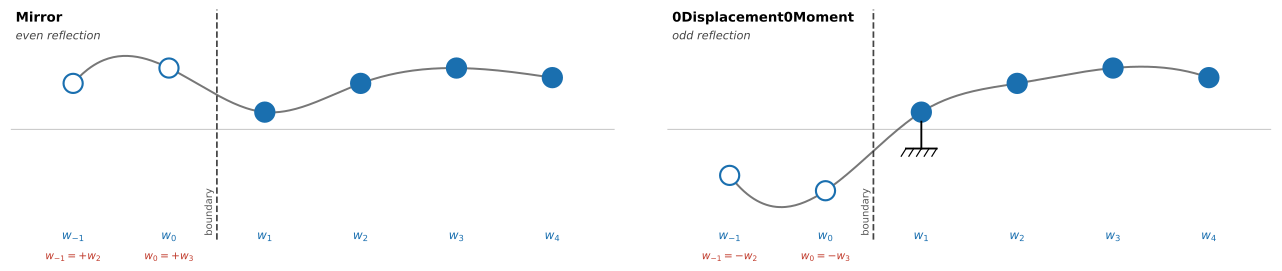
Even reflection (mirror, left) vs. odd reflection (zero_displacement_zero_moment, right):
the same four real nodes produce ghost values of opposite sign.
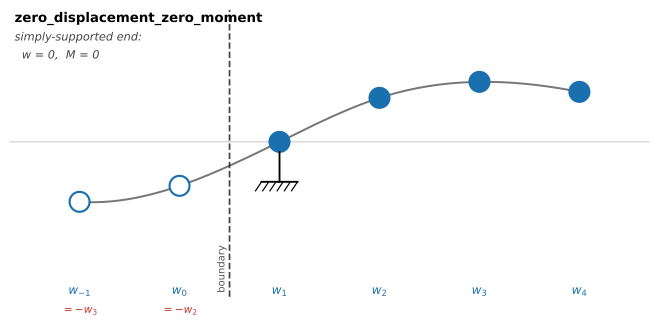
Simply supported — zero deflection, free to rotate; no bending moment transmitted.
zero_moment_zero_shear
The natural condition at a free edge: no bending moment and no shear force are transmitted across the boundary (Wickert, 2016, Table 1). Combined with an edge-applied load — a vertical point force supplies \(V_0\), a closely-spaced couple supplies \(M_0\) — it produces the classical broken-plate response of Turcotte and Schubert: the load carries the inhomogeneity through the loading vector while the BC matrix stays homogeneous.
Standard names: free end or free edge (structural mechanics); broken plate (geophysics). “Broken plate” is well established in the lithospheric flexure literature, referring to a plate whose edge is fractured and therefore transmits neither bending moment nor shear.
Geological context: zero_moment_zero_shear is the most physically motivated
of the five conditions for Earth science applications:
Passive or rifted continental margin, where the plate edge is effectively free
Broken-plate flexure (Turcotte & Schubert) with an edge load applied at the boundary node
Subduction trench and outer rise, where slab pull acts as an edge-applied vertical force
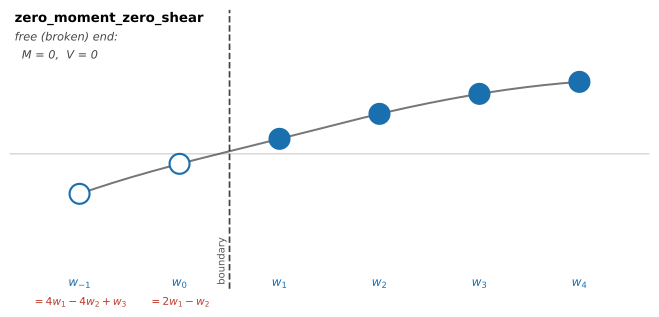
Free end — no bending moment and no shear force; the plate ends freely (“broken plate”).
zero_slope_zero_shear
Even reflection at the boundary: the system is identical on both sides,
so only half the domain need be modelled. The deflection at the ghost
node beyond the boundary equals the deflection at the corresponding
interior node (\(w_\text{ghost} = +w_\text{interior}\)), the plate is
horizontal at the boundary, and the deflection there is generally non-zero.
Naturally compatible with cosine-series (Discrete Cosine Transform)
solutions. For the distinction between even and odd reflections, see
Contrast with mirror in the zero_displacement_zero_moment section above.
Short alias: mirror — accepted without any warning and normalised to
zero_slope_zero_shear internally.
Standard names: No standard structural-mechanics or geophysical name. The condition is universally understood as a symmetry or mirror boundary.
Why the even-reflection ghost node enforces zero slope and zero shear: the rule \(w_\text{ghost} = +w_\text{interior}\) makes both the slope and the shear force vanish at the boundary automatically. In the central-difference stencil, the slope at the boundary node is
and the third derivative (shear force) similarly cancels by the same even symmetry:
The even-reflection ghost-node rule therefore simultaneously enforces
\(\mathrm{d}w/\mathrm{d}x = 0\) and
\(\mathrm{d}^3w/\mathrm{d}x^3 = 0\) — precisely the
zero_slope_zero_shear prescription.
Geological context: zero_slope_zero_shear applies wherever the load and plate
geometry are symmetric about the boundary plane:
One flank of a mountain range, orogenic belt, or subduction trench
One side of a continental ice sheet or ice cap
Half of a foreland basin profile
One quarter of a bilaterally symmetric ice dome or volcanic edifice (
mirroron two perpendicular axes)
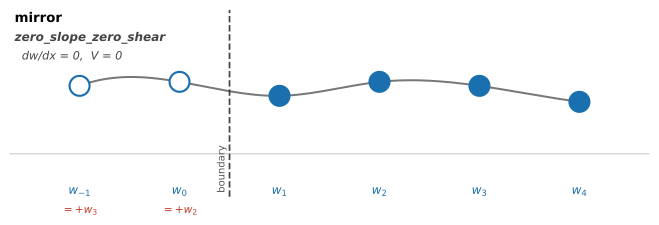
Symmetry plane — even reflection; use when the system is symmetric about the boundary.
periodic
Wrap-around: the domain tiles infinitely in the direction normal to that edge, and the solution wraps so that opposite edges are connected. Native to FFT-based spectral solutions, where periodicity is inherent to the transform.
For the FFT solver, periodic is applied per opposite-edge pair: setting both
bc_west and bc_east to periodic makes the x-axis exactly periodic;
setting both bc_north and bc_south to periodic makes the y-axis
exactly periodic. Mixed axes are valid — for example, x-periodic and y-padded.
A UserWarning is raised if only one side of a pair is periodic.
For the finite-difference solver a one-sided periodic is not well-posed and
raises a ValueError; set allow_unpaired_periodic = True to override the
guard and solve anyway (the deflection near that edge is not a valid solution).
Standard names: No standard structural-mechanics or geophysical name.
Geological context: periodic is appropriate when the load pattern
genuinely repeats, or when the domain is large enough relative to the
flexural wavelength that the periodic images of the load do not influence
the region of interest:
Seamount or volcanic chain
Long linear load — mountain belt, fold-and-thrust belt, subduction trench, or rift system — where individual valley structure is below the flexural wavelength (though
mirrorat both flanks may be preferable for a bilaterally symmetric belt)Continental-scale glacial load
Broad-scale FFT calculations
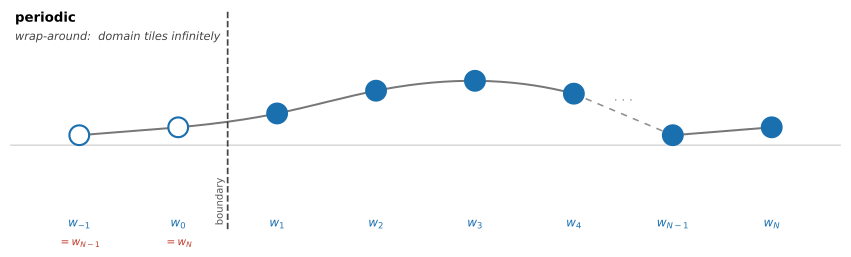
periodic — the domain wraps around; opposite edges are connected.
no_outside_loads
Added in version 2.0.0: Support for no_outside_loads in the finite-difference solver with automatic domain padding.
For the FFT solver and the analytical (SAS / SAS_NG) methods, this is the native assumption
and has always been available.
Short alias: infinite — accepted without any warning and normalised to
no_outside_loads internally.
Emulates a plate that extends beyond the model domain with no loads applied
outside. The finite-difference solver automatically pads the domain by at
least one flexural wavelength
(\(\lambda_\alpha = 2\pi\alpha\), where \(\alpha = (D / \Delta\rho\,g)^{1/4}\)
is the flexural parameter) on each side where this
condition is applied, solves on the extended domain with
zero_displacement_zero_slope at the outer edge, then trims the result
back to the original extent. The padding width and the solve are
deterministic given the physical parameters, so the feature is safe to use
in coupling loops.
no_outside_loads may be applied to any subset of edges — for example,
west and east only while north and south use a different condition.
Geological context: no_outside_loads is the most physically appropriate
FD condition when the load is entirely contained within the model domain and
the surrounding lithosphere is unloaded. Natural choices include:
Any self-contained load (seamount, ice cap, sedimentary basin)
Coupling gFlex to a landscape evolution or ice-sheet model where the loaded region is surrounded by unloaded lithosphere
FFT and SAS: The FFT solver zero-pads non-periodic axes by default, which
is equivalent to no_outside_loads for those axes. Explicitly setting
FFT edges to no_outside_loads produces the same result and suppresses any
partial-periodic warning. SAS / SAS_NG always assume no_outside_loads —
it is the native assumption of the analytical superposition approach.
Prescribed (non-zero) boundary values
Added in version 2.0.0.
By default every boundary condition above enforces homogeneous constraints
— the two named quantities are zero at the edge. The finite-difference solver
also supports prescribed (non-zero) values by passing a dict in place
of a BC string. This is the natural way to model a plate whose edge carries
an applied load: for example, prescribing the shear force at a free end to
represent slab pull at an ocean trench (the classical broken-plate scenario
of Turcotte and Schubert, 2002), or setting a non-zero boundary displacement
when coupling gFlex to another model.
This is available in F1D and F2D with
method = 'fd'. Passing a dict BC to any other solver raises
ValueError.
Relationship to string BCs
A dict BC uses the same finite-difference stencil as the equivalent string
BC. The prescribed values enter as an additive correction to the right-hand
side of the linear system — the coefficient matrix is unchanged. As a
consequence, {"moment": 0.0, "shear": 0.0} produces exactly the same
solution as the string "zero_moment_zero_shear": both constrain the same
stencil structure and the RHS correction is zero. Only non-zero values
change the solution.
Syntax
Set the BC attribute for a given edge to a dict with exactly two keys, where each key names a plate mechanical quantity and each value is either a scalar or a 1-D NumPy array:
flex.bc_west = {"moment": 0.0, "shear": V0}          # broken-plate edge load
flex.bc_west = {"displacement": 0.0, "slope": theta}  # prescribed rotation
flex.bc_east = {"displacement": w_array, "moment": 0.0}
The four valid keys are:
Key |
Symbol |
Prescribed quantity |
|---|---|---|
|
\(w\) |
Vertical deflection [m] |
|
\(dw/dx\) |
Plate slope (dimensionless) |
|
\(M\) |
Bending moment per unit edge length [N, i.e. N·m m⁻¹] |
|
\(V\) |
Shear force per unit edge length [N m⁻¹] |
Valid pairs
Each dict must contain exactly two keys whose combination corresponds to one of the four supported BC types:
Dict keys |
Equivalent homogeneous BC |
|---|---|
|
|
|
|
|
|
|
|
The two work-conjugate pairs — {"displacement", "shear"} and
{"slope", "moment"} — are ill-posed and raise ValueError.
Array values (2-D only)
In 2-D, values may be 1-D arrays that vary along the edge. An array assigned to a north or south edge must have length equal to the number of columns; one assigned to a west or east edge must have length equal to the number of rows. Scalar values are broadcast to the full edge.
Example: broken-plate edge load (1-D)
The classical broken-plate scenario (Turcotte & Schubert, 2002) represents a semi-infinite oceanic plate carrying a vertical point force \(V_0\) at the trench end — the idealisation of slab pull at a subduction zone. The plate bends downward at the trench and a forebulge (outer rise) develops at approximately \(\pi\alpha/2\) from the loaded end.
The boundary condition is zero moment and prescribed (downward) shear at the
west end, with a free zero_moment_zero_shear condition at the far east end:
import numpy as np
from gflex import F1D

# Physical parameters
E        = 65e9     # Pa — Young's modulus
nu       = 0.25
rho_m    = 3300.0   # kg m⁻³ — mantle density
rho_fill = 0.0      # kg m⁻³ — air infill
g        = 9.8      # m s⁻²
Te       = 30e3     # m  — elastic thickness

# Derived quantities
D     = E * Te**3 / (12.0 * (1.0 - nu**2))          # flexural rigidity
lam   = ((rho_m - rho_fill) * g / (4.0 * D)) ** 0.25
alpha = 1.0 / lam                                    # flexural parameter ≈ 66 km

# Domain: 10 α long, 401 nodes
nx = 401
dx = 10.0 * alpha / (nx - 1)

# Slab-pull shear force at the trench (negative = downward), N/m
V0 = -1e12

flex = F1D()
flex.quiet    = True
flex.method   = 'fd'
flex.g = g;  flex.E = E;  flex.nu = nu
flex.rho_m = rho_m;  flex.rho_fill = rho_fill
flex.T_e      = Te
flex.qs       = np.zeros(nx)   # no distributed load — forcing is at the boundary
flex.dx       = dx
flex.bc_west  = {"moment": 0.0, "shear": V0}   # trench: zero moment, prescribed shear
flex.bc_east  = "zero_moment_zero_shear"         # free far end

flex.initialize()
flex.run()
w = flex.w   # deflection [m]; w[0] ≈ −933 m (trench), forebulge ≈ +63 m at x ≈ 156 km
flex.finalize()
The result matches the analytical solution \(w(x) = \frac{V_0}{2D\lambda^3}\,e^{-\lambda x}\cos(\lambda x)\) to within 0.02 % (L-∞ relative error).
A standalone version of this script with plotting is provided in
input/run_in_script_prescribed_bc_1D.py.