gFlex
Multiple methods to solve elastic plate flexure, designed for applications to Earth’s lithosphere.
gFlex computes lithospheric flexural isostasy — the bending of Earth’s elastic outer shell under surface loads such as ice sheets, sediment, lava flows, or water. Both one-dimensional (profile) and two-dimensional (map view) solutions are supported, using either a finite-difference method (which handles spatially variable elastic thickness) or superposition of analytical solutions (fast, for constant elastic thickness).
The deflection \(w\) satisfies
where \(\boldsymbol{\sigma} : \nabla\nabla w\) is the double contraction of the in-plane stress tensor with the Hessian of \(w\), \(q\) [Pa] is the applied surface normal stress, \(\Delta\rho = \rho_m - \rho_\text{fill}\) [kg m⁻³] is the mantle minus infill density, \(g\) [m s⁻²] is gravitational acceleration, and \(D = E T_e^3 / \bigl[12(1 - \nu^2)\bigr]\) is the flexural rigidity (\(E\) = Young’s modulus, \(T_e\) = elastic thickness, \(\nu\) = Poisson’s ratio). See Theory and Numerics for the full expanded equations and physical interpretation of each term.
Note
When you use gFlex, please cite:
Wickert, A. D. (2016), Open-source modular solutions for flexural isostasy: gFlex v1.0, Geosci. Model Dev., 9(3), 997–1017.
Workflow
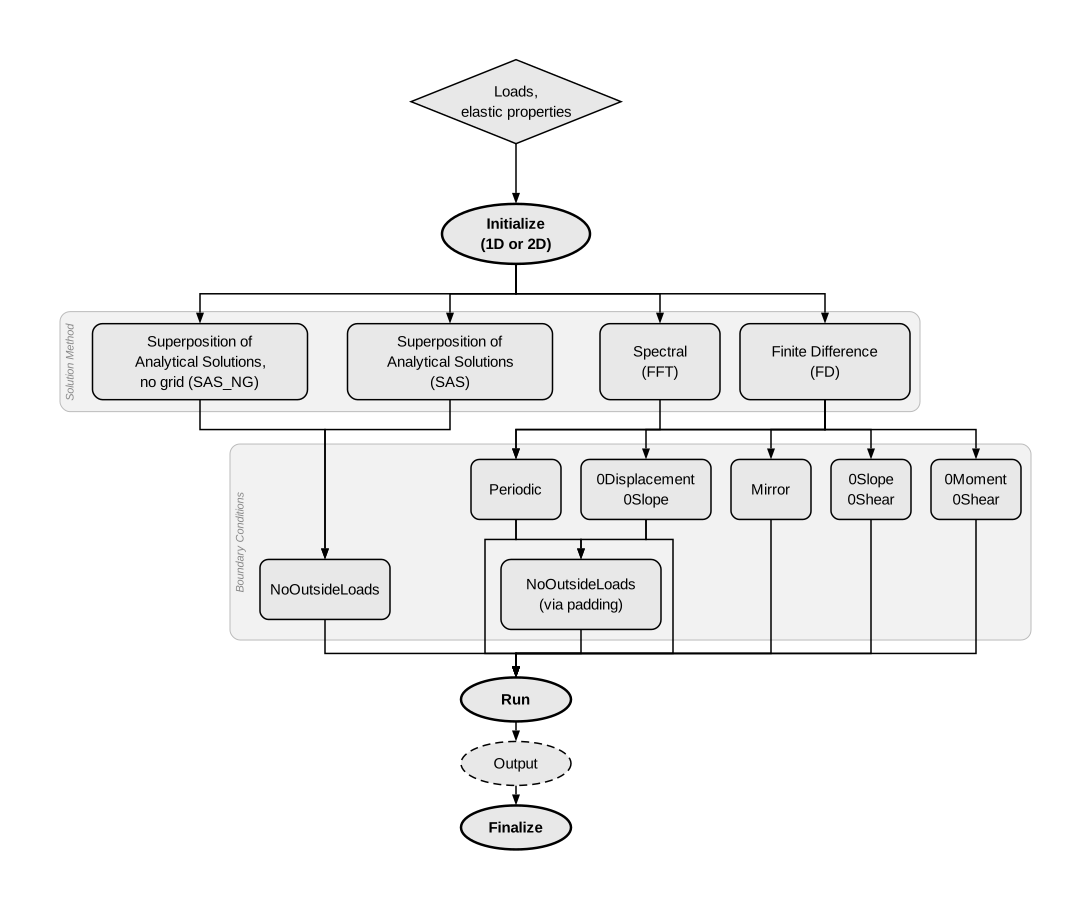
gFlex computational workflow. Bold-bordered nodes are CSDMS Basic Model Interface (BMI) methods. Boundary conditions apply to finite-difference solutions; padding-based approximations are also shown.
Installation
pip install gflex
gFlex requires Python ≥ 3.11 and depends on NumPy, SciPy, and Matplotlib.
Note
Downstream tools that embed gFlex (QGIS Processing provider, GRASS GIS
addons) should pin gflex>=2.0.0 in their requirements.
Quick start
2-D finite-difference deflection under a rectangular load:
import numpy as np
from gflex import F2D

flex = F2D()
flex.quiet = True
flex.method = 'fd'
flex.g = 9.8
flex.E = 65e9
flex.nu = 0.25
flex.rho_m = 3300.
flex.rho_fill = 0.
flex.T_e = 35e3 * np.ones((50, 50))   # uniform 35 km elastic thickness
flex.qs = np.zeros((50, 50))
flex.qs[10:40, 10:40] = 1e6          # 150 × 150 km load at 1 MPa
flex.dx = flex.dy = 5000.            # 5 km grid
flex.bc_west = flex.bc_south = flex.bc_north = 'zero_displacement_zero_slope'
flex.bc_east = 'zero_moment_zero_shear'
flex.initialize()
flex.run()

deflection = flex.w   # (50, 50) array; negative values = downward
flex.finalize()        # releases w, qs, and the coefficient matrix
Configuration files
As an alternative to the programmatic API, gFlex can be driven by a
configuration file — passed to the gflex CLI or to the
F1D / F2D constructor. The file must
be YAML (.yaml / .yml); see input/input_f1d.yaml and
input/input_f2d.yaml for complete 1-D and 2-D examples.
A minimal 2-D YAML configuration:
mode:
  dimension: 2
  method: fd
parameter:
  youngs_modulus: 6.5e10
  poissons_ratio: 0.25
  gravitational_acceleration: 9.8
  mantle_density: 3300
  infill_material_density: 0
input:
  loads: path/to/loads.txt
  elastic_thickness: path/to/Te.txt
output:
  plot: both
numerical:
  grid_spacing_x: 4000
  boundary_condition_west: zero_moment_zero_shear
  boundary_condition_east: zero_displacement_zero_slope
numerical2D:
  grid_spacing_y: 4000
  boundary_condition_north: zero_slope_zero_shear
  boundary_condition_south: zero_slope_zero_shear
Run from the command line:
gflex path/to/config.yaml
See Configuration Files for a full parameter reference and annotated examples.
Interfaces
gFlex can be accessed through several front-ends depending on your workflow:
Python and command-line
Interface |
\(T_e\) |
Description |
|---|---|---|
scalar or array |
Full programmatic control. The primary interface; all other front-ends call into it. See the Tutorial and API Reference. |
|
CLI ( |
scalar or array |
Drive gFlex from a YAML configuration file with no Python code. See Configuration Files. |
Modelling frameworks
Interface |
\(T_e\) |
Description |
|---|---|---|
CSDMS BMI ( |
scalar or array |
CSDMS Basic Model Interface for coupling in the CSDMS framework.
Requires |
Landlab component ( |
scalar or array |
Landlab Earth-surface modelling framework component. Uses
|
GIS
Interface |
\(T_e\) |
Description |
|---|---|---|
GRASS GIS ( |
scalar or array |
Raster and vector interfaces for use inside a GRASS GIS session.
|
QGIS Processing provider ( |
scalar or array |
No-code access from the QGIS Processing Toolbox and Graphical Modeler. Supports all 2-D methods, variable \(T_e\), all boundary conditions, and in-plane stresses. processing_gflex. |
Contents
- Theory and Numerics
- Boundary Conditions
- Tutorial
- Example: Greenland
- API Reference
- Configuration Files
- Numerical Accuracy
- Analytical solutions (
sasandsas_ng) - FFT spectral solver
- Finite difference solver (
fd) - 2-D finite-difference solver: second-order convergence
- 1-D
zero_displacement_zero_slopeboundary condition: MMS verification - 1-D and 2-D
zero_moment_zero_shearboundary condition: MMS verification - 2-D
zero_displacement_zero_slopeboundary condition: MMS verification zero_slope_zero_shear(mirror) boundary condition: MMS verification- 1-D and 2-D
zero_displacement_zero_momentboundary condition: MMS verification - Variable elastic thickness: 1-D MMS verification
- Variable elastic thickness: 2-D MMS verification
- Analytical solutions (
- Performance
- References
- Release Notes
Documentation prepared with AI assistance (Claude, Anthropic) drawing on the gFlex source code and Wickert (2016), reviewed by A. D. Wickert.