Configuration Files
gFlex can be driven by a configuration file rather than (or alongside)
the programmatic Python API. Pass the file path to the gflex CLI or
to an F1D / F2D constructor.
Two formats are supported. The file extension determines which parser is used:
YAML (
.yamlor.yml) — recommended for new configurations.INI (any other extension) — the original legacy format.
Both formats use the same section names and parameter keys.
Parameters
mode section
dimension1or2. Selects a 1-D (profile) or 2-D (map-view) flexural solution.methodSolution method:
FD— Finite Difference. Supports spatially variable elastic thickness. Requires a grid (dx, anddyin 2-D).FFT— Spectral (Fast Fourier Transform). 2-D only. Requires scalar (uniform) \(T_e\). Spectrally accurate and fast. When all boundary conditions arePeriodicthe domain tiles exactly; for any other boundary condition the load is zero-padded by \(4\alpha\) on each side, approximating theNoOutsideLoadscondition. In-plane stresses (\(\sigma_{xx}\), \(\sigma_{yy}\), \(\sigma_{xy}\)) are supported.SAS— Superposition of Analytical Solutions. Constant elastic thickness only; fast and analytically exact.SAS_NG— SAS on an unstructured point set (NG = “no grid”). Load and output locations are arbitrary (x, q0) or (x, y, q0) columns; seeLoadsbelow.
PlateSolutionType(2-D only) Plate bending equation variant:
vWC1994— van Wees & Cloetingh (1994); recommended.G2009— Govers et al. (2009); less robust near boundaries.
parameter section
YoungsModulusYoung’s modulus \(E\) [Pa]. Typical lithospheric value: 65 GPa (
6.5e10).PoissonsRatioPoisson’s ratio \(\nu\) [dimensionless]. Typical value: 0.25.
GravAccelGravitational acceleration \(g\) [m s⁻²]. Earth standard: 9.8.
MantleDensityDensity of the mantle \(\rho_m\) [kg m⁻³]. Typical value: 3300.
InfillMaterialDensityDensity of the material that fills (or vacates) the flexural depression \(\rho_\text{fill}\) [kg m⁻³]. Common values:
0— air (no infill)1030— seawater2000–2700— sediment
If the infill density varies spatially (e.g., at a subsiding shoreline that progressively floods), iterate externally: flex, update the inundation mask, re-flex, repeat.
input section
LoadsPath to the load file.
Gridded methods (FD, SAS): a space-delimited array of surface normal stresses [Pa] (\(\rho g h\)). Grid cell area (\(\Delta x \times \Delta y\)) is applied internally to convert stress to force.
SAS_NG: a space-delimited file with columns
(x, q0)in 1-D or(x, y, q0)in 2-D, where q0 is a point force [N].
Paths are resolved relative to the directory containing the configuration file.
ElasticThicknessElastic thickness [m]. Either a scalar value or a path to a space-delimited array. Arrays are required for FD solutions with spatially variable Te. Use
smooth_pad_Te()andpad_domain()(2-D) orsmooth_pad_Te_1d()andpad_domain_1d()(1-D) to extend a variable-Te grid with a smooth boundary buffer before running.xw,yw(SAS_NG only) Vectors of x (and y for 2-D) coordinates at which to evaluate deflection. If omitted, deflection is evaluated at the load points.
output section
DeflectionOutPath for writing deflection output as a space-delimited ASCII file. Leave blank to suppress file output.
PlotControls inline plotting after the run:
q— plot the applied load.w— plot the deflection.both— deflection and load in separate subplots.combo— (1-D only) deflection with the load overlaid.
Any other value (or blank) suppresses plotting.
numerical section
GridSpacing_xGrid cell size in the x-direction [m].
BoundaryCondition_West,BoundaryCondition_EastBoundary conditions on the west and east edges.
For FD solutions:
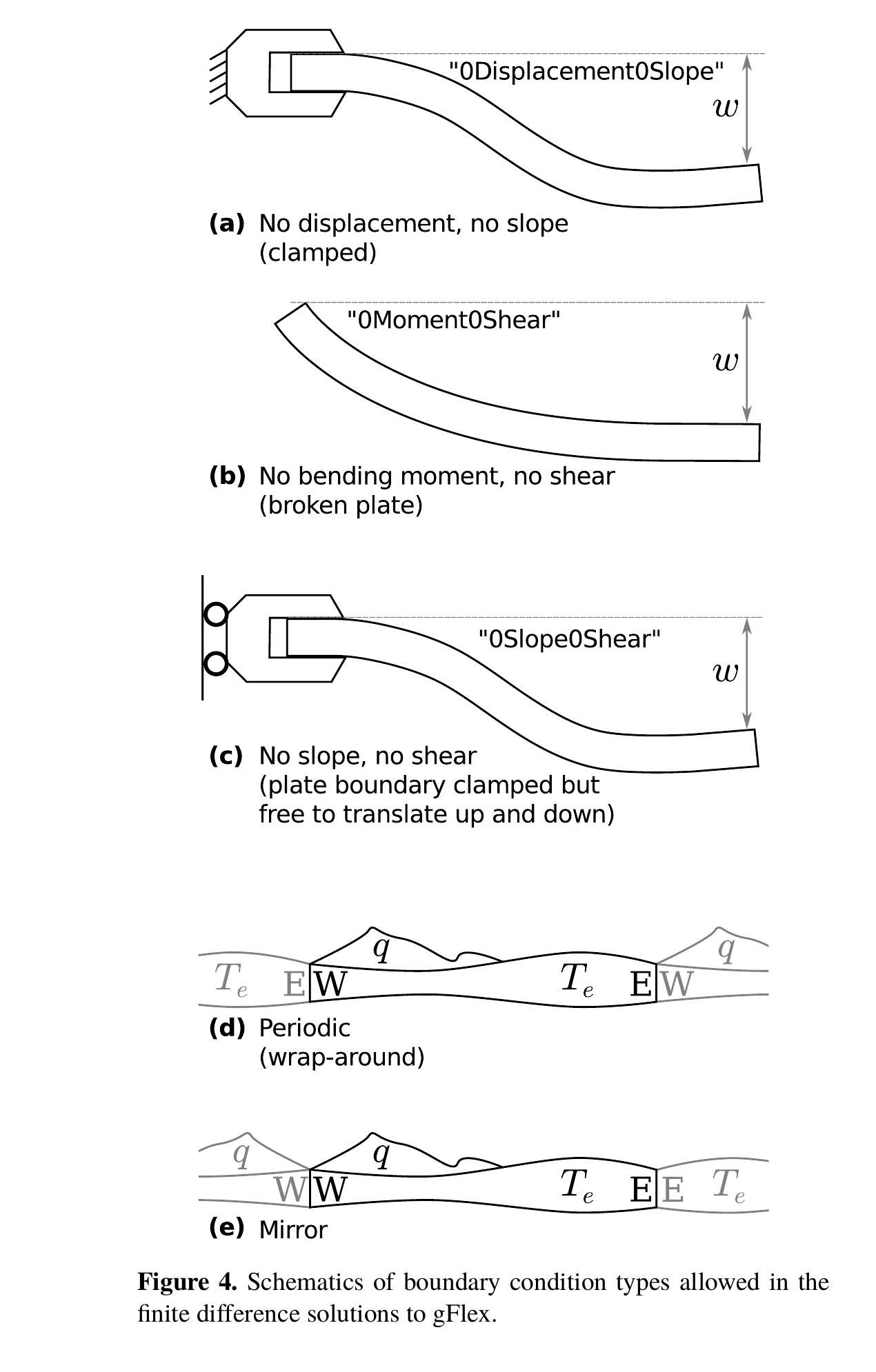
Schematics of the five FD boundary condition types (a–e). Reproduced from Wickert (2016), Fig. 4; CC BY 3.0.
0Displacement0Slope— zero displacement and slope; plate is pinned to zero deflection at the boundary.0Moment0Shear— zero bending moment and shear force; broken plate with a free cantilever end (Wickert, 2016, Table 1).0Slope0Shear— zero slope and shear force; the plate is level at the boundary but free to deflect there, with no shear transmitted. Wickert (2016) calls this “free displacement of a horizontally clamped boundary.” It is superficially similar toMirror(both enforce zero slope), but uses a different finite-difference stencil and produces noticeably different solutions; preferMirrorfor symmetry problems.Mirror— even reflection at the boundary; model only half of a symmetric system (e.g., one flank of a mountain range or ice sheet).Periodic— wrap-around; the domain tiles infinitely in both directions.
For SAS / SAS_NG:
NoOutsideLoads(assumed if left blank).Flexural solutions can be sensitive to boundary conditions; choose carefully and consider using
pad_domain()(2-D) orpad_domain_1d()(1-D) to push boundaries away from the region of interest.SolverLinear system solver for FD:
direct— sparse direct solver; recommended for most grids.iterative— lower peak memory on very large grids; slower.
ConvergenceToleranceRelative residual tolerance passed as
rtolto the LGMRES solver. Only used whenSolver = iterative. Default:1.0e-3. Decrease for higher accuracy at the cost of more iterations; the solver falls back to a direct solve if LGMRES does not converge.
Note
In-plane stresses (\(\sigma_{xx}\), \(\sigma_{yy}\),
\(\sigma_{xy}\) [Pa]) cannot be set from a configuration file.
They must be assigned programmatically before calling
initialize():
flex.sigma_xx = 1e6   # east–west compression [Pa]
flex.sigma_yy = 0.
flex.sigma_xy = 0.
All three default to zero if not set. They are supported by FD
and FFT in 2-D, and by FD and FFT in 1-D (sigma_xx
only). Setting them with SAS or SAS_NG raises a warning and
has no effect. See Theory for the governing equations.
numerical2D section
GridSpacing_yGrid cell size in the y-direction [m].
BoundaryCondition_North,BoundaryCondition_SouthSame options as
BoundaryCondition_West/BoundaryCondition_East.latlontrue/false. Interpret input coordinates as geographic latitude and longitude. Default:false.PlanetaryRadiusPlanetary radius [m]. Required when
latlon = true. Earth: 6 371 000 m.
verbosity section
Verbosetrue/false. Print progress messages during the run. Default:true.Debugtrue/false. Print internal arrays and solver diagnostics. Default:false.Quiettrue/false. Suppress all output. OverridesVerboseandDebug. Default:false.
Complete examples
1-D finite-difference example (YAML)
# All units are SI.

mode:
  dimension: 1
  method: FD

parameter:
  YoungsModulus: 6.5e10
  PoissonsRatio: 0.25
  GravAccel: 9.8
  MantleDensity: 3300
  InfillMaterialDensity: 0

input:
  Loads: q0_sample/1D/central_block.txt
  ElasticThickness: Te_sample/1D/8km_20km_ramp.txt

output:
  DeflectionOut: ""
  Plot: combo          # overlay deflection and load (1-D only)

numerical:
  GridSpacing_x: 6000
  BoundaryCondition_West: Periodic
  BoundaryCondition_East: Periodic
  Solver: direct
  ConvergenceTolerance: 0.001

verbosity:
  Verbose: false
  Debug: false
  Quiet: false
2-D finite-difference example (YAML)
# All units are SI.

mode:
  dimension: 2
  method: FD
  PlateSolutionType: vWC1994   # van Wees & Cloetingh (1994); recommended

parameter:
  YoungsModulus: 6.5e10
  PoissonsRatio: 0.25
  GravAccel: 9.8
  MantleDensity: 3300
  InfillMaterialDensity: 0

input:
  Loads: q0_sample/2D/diag.txt
  ElasticThickness: Te_sample/2D/fault_24-30.txt

output:
  DeflectionOut: ""
  Plot: both

numerical:
  GridSpacing_x: 4000
  BoundaryCondition_West: 0Moment0Shear
  BoundaryCondition_East: 0Displacement0Slope
  Solver: direct
  ConvergenceTolerance: 1.0e-3

numerical2D:
  GridSpacing_y: 4000
  BoundaryCondition_North: Mirror
  BoundaryCondition_South: 0Slope0Shear

verbosity:
  Verbose: false
  Debug: false
  Quiet: false
INI format (legacy)
The INI format uses the same section names and parameter keys as YAML, with
[section] headers and key=value pairs. Comments begin with ;.
The file extension is not restricted — the absence of a .yaml / .yml
suffix causes gFlex to treat the file as INI.
Equivalent 1-D example in INI:
; All units are SI.

[mode]
dimension=1
method=FD

[parameter]
YoungsModulus=6.5E10
PoissonsRatio=0.25
GravAccel=9.8
MantleDensity=3300
InfillMaterialDensity=0

[input]
Loads=q0_sample/1D/central_block.txt
ElasticThickness=Te_sample/1D/8km_20km_ramp.txt

[output]
DeflectionOut=
Plot=combo

[numerical]
GridSpacing_x=6000
BoundaryCondition_West=Periodic
BoundaryCondition_East=Periodic
Solver=direct
ConvergenceTolerance=0.001

[verbosity]
Verbose=false
Debug=false
Quiet=false
Annotated reference file (input/input_help)
The file input/input_help in the repository is an annotated INI
template showing every parameter with inline comments. It is reproduced
here (with corrections) for quick reference.
; input_help
; All units are SI. Not all entries are needed.
; Standard parameter values for Earth are included.

[mode]
; 1 (line) or 2 (surface) dimensions
dimension=2
; Solution method: FD (Finite Difference), SAS (Spatial domain
; analytical solutions), or SAS_NG (SAS, but on an unstructured
; grid — NG = "no grid").
; For SAS_NG, 1D data must be provided and will be returned in
; two columns: (x,q0) --> (x,w). 2D data are similar, except
; will be of the form (x,y,[q0/in or w/out]).
method=SAS
; Plate solutions can be:
;  * vWC1994 (best), or
;  * G2009 (from Govers et al., 2009; not bad, but not
;           as robust as vWC1994)
PlateSolutionType=vWC1994

[parameter]
YoungsModulus=65E9
PoissonsRatio=0.25
GravAccel=9.8
MantleDensity=3300
; This is the density of material (e.g., air, water)
; that is filling (or leaving) the hole that was
; created by flexure. If you do not have a constant
; density of infilling material, for example, at a
; subsiding shoreline, you must instead iterate.
InfillMaterialDensity=0

[input]
; space-delimited array of loads
; stresses (rho*g*h) if gridded — dx (and if applicable, dy) will be
;   applied to convert them into forces
; forces (rho*g*h*Area) if not gridded (SAS_NG)
; If the solution method is SAS_NG, this file should be of the format
; (x,[y],q0) and the code will sort it out.
Loads=q0_sample/2D/central_square_load.txt
;
; scalar value or space-delimited array of elastic thickness(es) [m]
; array required for finite difference solutions with variable Te
ElasticThickness=Te_sample/2D/10km_const.txt
;
; xw and yw are vectors of desired output points for the SAS_NG method.
; If not specified, the solution is calculated at the load points.
; Ignored for other solution methods.
xw=
yw=

[output]
; DeflectionOut is for writing an output file.
; If blank, no output file is written.
; Otherwise, a space-delimited ASCII file of deflections is written
; to this path.
DeflectionOut=tmpout.txt
;
; Acceptable inputs to "Plot" are q0 (loads), w (deflection), or both;
; any other entry results in no plotting.
; Automatically plots a 1D line or 2D surface based on "dimension".
Plot=both

[numerical]
; dx [m]
GridSpacing_x=
;
; Boundary conditions can be:
; (FD): 0Slope0Shear, 0Moment0Shear, 0Displacement0Slope, Mirror, or Periodic
; For SAS or SAS_NG, NoOutsideLoads is valid, and no entry defaults to this
BoundaryCondition_West=
BoundaryCondition_East=
;
; Solver can be direct or iterative
Solver=
; Tolerance between iterations [m]
; If you have chosen an iterative solution type, gFlex will iterate
; until the change between two subsequent iterations is below this value.
; Set as 0 if you don't want to iterate.
ConvergenceTolerance=1E-3

[numerical2D]
; dy [m]
GridSpacing_y=
;
; Boundary conditions can be:
; (FD): 0Slope0Shear, 0Moment0Shear, 0Displacement0Slope, Mirror, or Periodic
; For SAS or SAS_NG, NoOutsideLoads is valid, and no entry defaults to this
BoundaryCondition_North=
BoundaryCondition_South=
;
; Flag to enable lat/lon input (true/false). By default, this is false.
latlon=
; radius of planet [m], for lat/lon solutions
PlanetaryRadius=

[verbosity]
; true/false. Defaults to true.
Verbose=
; true/false. Defaults to false.
Debug=
; true/false -- total silence if true. Defaults to false.
Quiet=